ResidencesConcept #3
a charger for every resident, zero admin
One shared system on the building's existing connection: every parking space can have its own charger, every car is charged by morning, and AMP X VOLT runs the service, from the energy to the invoices. The syndic gets reports, not work.
- per car when power is available
- 22 kW
- per car when power is available
- peak-power grid fee, included in the monthly fee and energy price
- Shared
- peak-power grid fee, included in the monthly fee and energy price
- measurement of the whole building
- 100 ms
- measurement of the whole building
12:00
Daytime: most cars are away
How Concept #3 works
The building and the chargers share one connection
01
Measured, not guessed
Current clamps on the main cable read all three phases every 100 ms: the building and the chargers together.
02
A live budget
Charging budget = connection limit − what the building uses right now. When the building needs more, the chargers get less, instantly.
03
Patented phase switching
Each charger runs on the phase with the most headroom, so the whole connection is usable.
04
Shared by need
Power goes to the cars by need, departure time and price. Each driver picks Charge now or Cheapest energy in the app.
VOOL LMC · the brain in the main cabinet
One controller in the main cabinet runs the whole car park
VOOL LMC
up to 64 chargers per controller, cascadable
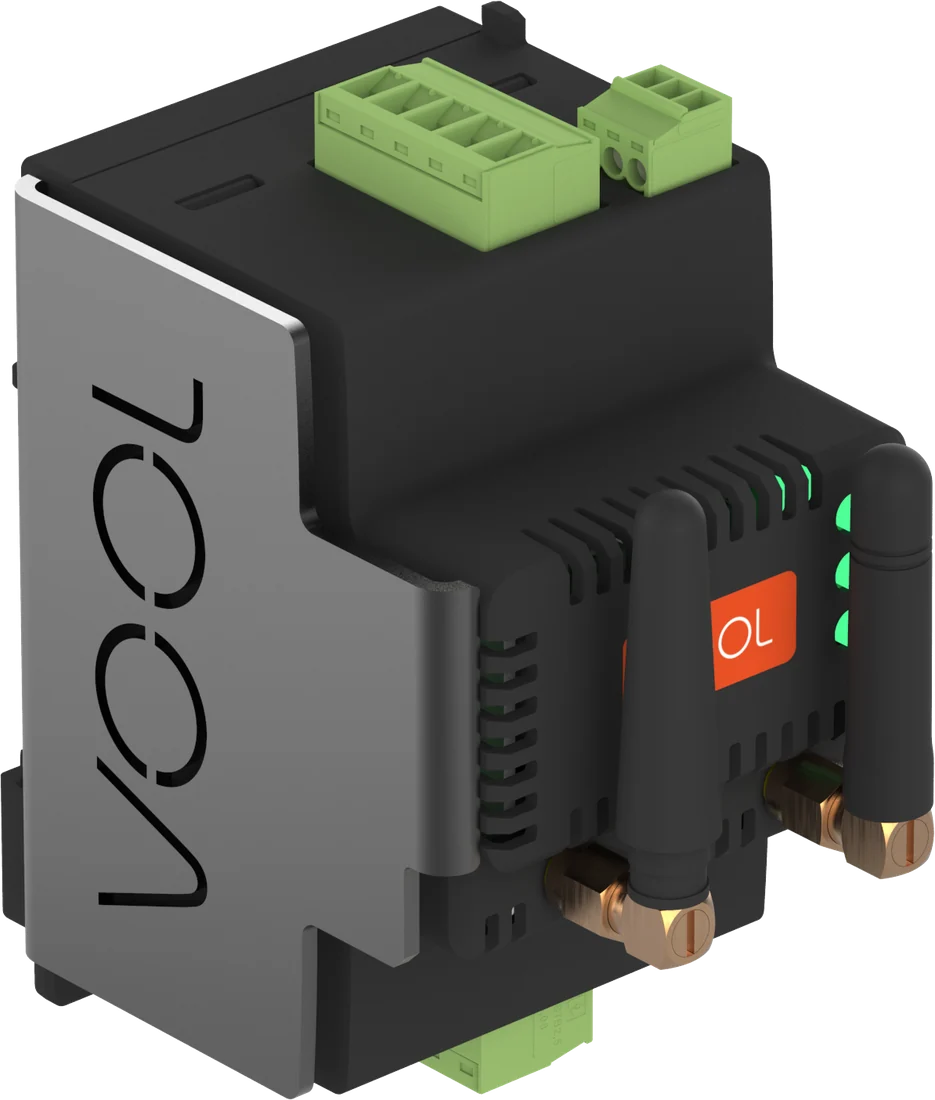
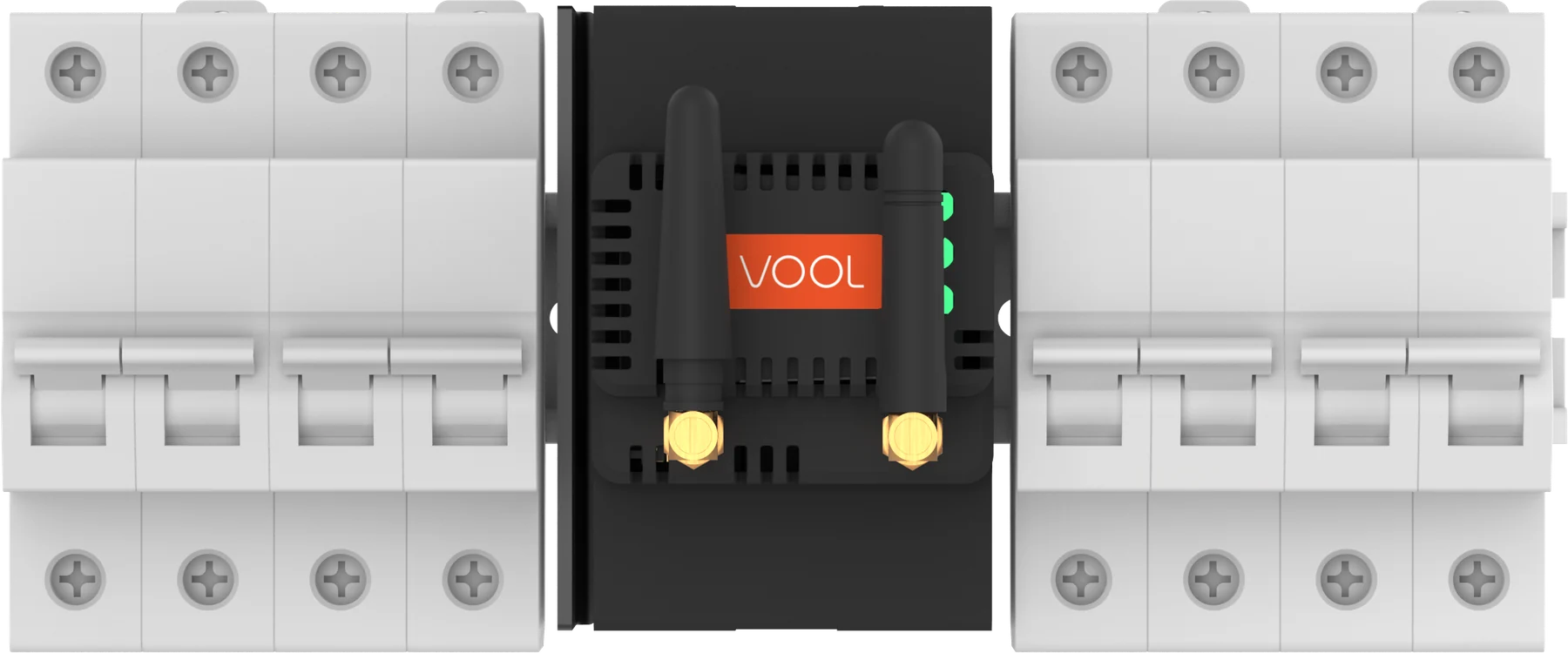
The VOOL load management controller sits on the DIN rail of the main cabinet, next to the breakers. Current clamps on the incoming cable tell it, ten times a second, what the building uses on each phase; it gives the chargers exactly what is left.
- Measures the whole connection every 100 ms, phase by phase
- Up to 64 chargers per controller, cascadable for larger sites
- Patented phase switching with VOOL chargers: up to 6× more chargers on the same connection
- Keeps managing locally when the internet is down
- Solar, battery and market prices via Modbus TCP and the EMS
24 hours in a residence
Every car plugged in, every car charged by morning
12:00
Daytime: most cars are away
In a typical residence 80% of the cars leave in the morning and return in the evening. The car that stays home is topped up when daytime prices are lowest.
- 12:00: Daytime: most cars are away. In a typical residence 80% of the cars leave in the morning and return in the evening. The car that stays home is topped up when daytime prices are lowest.
- 18:00: Every car plugs in on arrival. Between 17:00 and 20:00 most cars come home. Every space has its own charger, so nobody waits for a free one and nobody moves cars around at night.
- 19:30: Evening peak: building 400 A, chargers 100 A. The building takes 400 A of the 500 A connection. Only the cars set to Charge now draw the remaining 100 A, with priority and at the hour's market price. Nothing trips.
- 20:30: One tap moves charging to the night. The driver in bay 5 switches from Charge now to Cheapest energy with a ready-by time of 07:25. The car stops paying peak prices and finishes at night.
- 03:00: Night: building 100 A, chargers 400 A. The building is quiet and prices fall. The cars set to Cheapest energy charge in the cheapest hours, at full power.
- 07:00: Every car ready on time. Every plugged-in car has reached its target before its own departure time, whichever mode the driver chose, all on one 500 A connection.
One of our buildings
Offices, restaurants and 100 apartments on one 1,000 A connection
A mixed-use building: three large offices, two restaurants and 100 apartments. Each uses the building at a different time, so the same connection charges office cars by day and residents' cars by night.
08:00 – 18:00
Office cars charge by day
The apartments are quiet, so the offices' cars take the free capacity, and step back around the restaurants' lunch peak.
12:00 – 14:00 · 18:00 – 22:00
The restaurants come first
Kitchens set the building's peak. The building always has priority; the chargers take what is left.
22:00 – 06:00
Residents charge overnight
The building's load falls by more than half and the residents' cars charge at full power, full by morning.
Why more power per car
Three ways to equip a residence
| Chargers on each flat's own meter | Separate e-mobility connection | Concept #3 (AMP X VOLT) | |
|---|---|---|---|
| Power per car | Up to 11 kW, limited by the flat's band | Only 3–4 cars charge at once; the rest queue | Up to 22 kW when available; every car charged by morning |
| New grid connection | No | Yes, a new Creos connection | No |
| Peak-power grid fees | Each flat needs a bigger band: 12 kW +€12.74/month; 17 kW +€19.81 | Fees of the new connection | Shared: included in the monthly fee and the energy price; apartments keep their band |
| Admin for the syndic | Each owner on their own | Contracts, billing, support | None: AMP X VOLT invoices each user |
| Tariff | The flat's own supplier | Depends on the operator | €6.90/month + €0.29/kWh incl. VAT (current offer, follows the energy market) |
Creos indicative network tariffs from 1 January 2027 (version of 15 October 2026), subject to ILR approval. Full comparison.
Zero admin
Who does what
AMP X VOLT
- Site visit, offer for the shared part and each private part
- Creos and the subsidy file
- Installation with our partner electrician
- Energy supply, invoicing, user management, support
The syndic
- Puts the shared installation on the general assembly agenda
- Signs the shared-part order after the vote
- Receives reports, nothing to administer
Each co-owner
- Orders their own charger when they want one
- Plugs in and chooses the charging mode in the VOOL app
- Can also use any eMSP charging card
Resident pricing
What residents pay
- Monthly fee
- €6.90 per charger, incl. VAT, all administration included
- Smart charging
- €0.29 per kWh incl. VAT, car full by the time you set
- Charge now
- Immediate charging with priority, at the hour's market price
- Access
- VOOL app, or the resident's own eMSP card
- Metering
- Apartments keep their SMARTY meters; charging runs on a separate AMP X VOLT meter
- Aid 2026
- Shared system: 50% up to €40,000; each smart charger: 50% up to €1,200 (draft law, see subsidies)
Current offer, based on our analysis of about 400 residences; it follows energy-market trends and can change.
Against diesel
What 15,000 km a year costs
What 100 km costs you
Prices and other assumptions
Diesel car
€1,849
€12.32 / 100 km
Electric, public charging only
€1,593
€10.62 / 100 km
Electric, AMP X VOLT at home
€866
€5.77 / 100 km
€983saved per year against diesel
All prices incl. VAT. Diesel: Luxembourg average €2.054/l (EU Weekly Oil Bulletin, 26 Oct 2026). Home: AMP X VOLT resident tariff, current offer, €0.29/kWh + €6.90 per charger per month. Public: €0.59/kWh, a typical public AC tariff.
Installation
25 to 40% below competing offers
25–40%
below competing offers
collective systems, against competing offers residences showed us (AMP X VOLT, October 2026)
50%
aid on the shared system
up to €40,000 per building, 2026 regime (draft law)
6 tranches
for a 300-space car park
the shared part is built as owners order
Your role
Existing building or new development?
- 01
Syndics and co-owners of existing residences
The general assembly process, the AG pack, the modular build-out.
- 02
Developers of new residences
Every space ready from handover, a smaller connection, a selling point.
- 03
Check your building now
Ready for the general assembly? Three answers.
Ask your AI assistant
Residence questions
“What is Concept #3 for apartment buildings in Luxembourg?”
“Why not connect each charger to the apartment's own meter?”
“What happens with a separate e-mobility grid connection?”
“How much does charging cost a resident?”
Put it on the agenda of your next general assembly
We prepare the AG pack: cost per apartment, aid, modular build-out, timeline, subscription and draft resolution text.