TechnologyLoad and energy management
the chargers get what the building leaves
The VOOL load management controller sits at the grid connection, measures it ten times a second and gives the chargers exactly the power the building does not need. Above it, an EMS adds batteries, solar and market prices.
- measurement cycle
- 100 ms
- measurement cycle
- chargers per LMC
- 64
- chargers per LMC
- per space proved enough (50 spaces)
- 8 A
- per space proved enough (50 spaces)
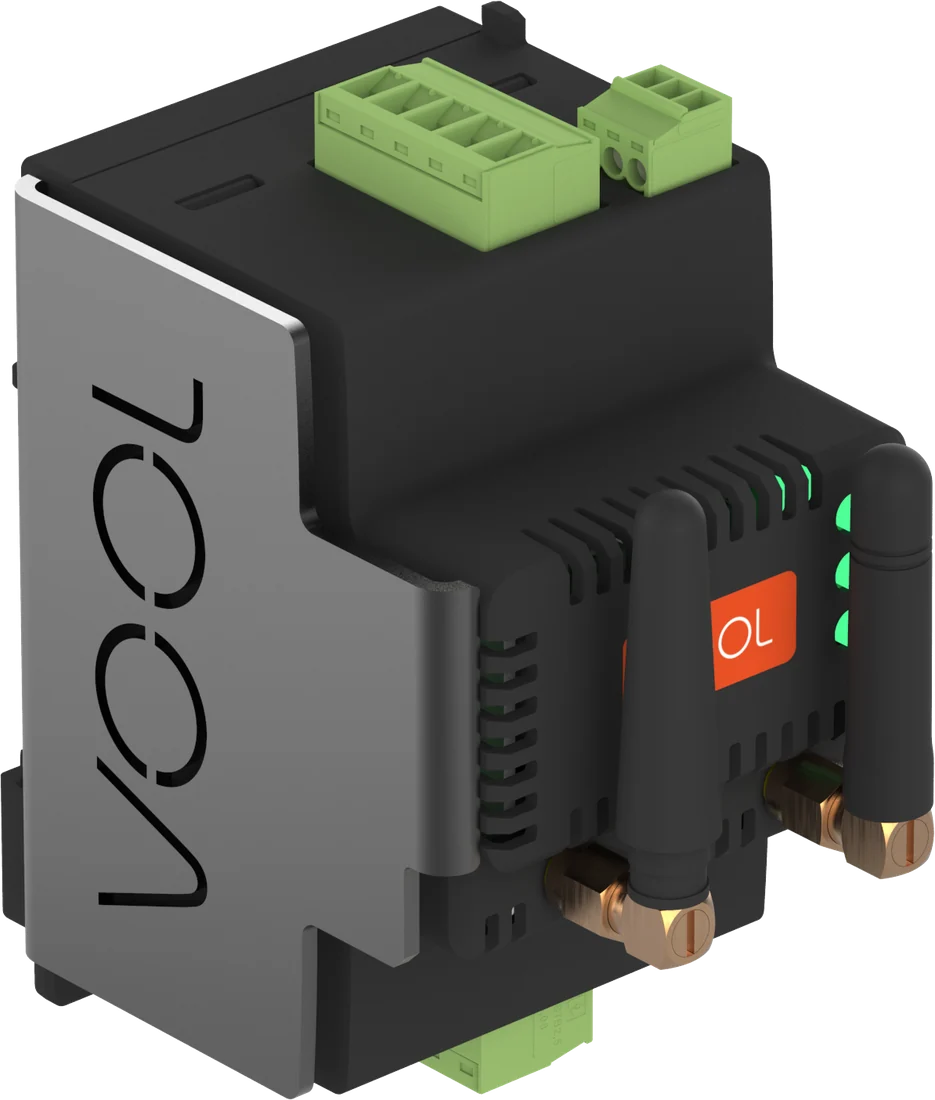
VOOL LMC
up to 64 chargers per controller, cascadable
Four levels
What the controller decides
01
Building-level load management
The whole connection measured every 100 ms; chargers get what the building leaves.
02
Patented phase switching
Each charger on the phase with the most headroom: the full connection is usable.
03
Source of energy
Grid at market price, battery or solar, whichever is best now.
04
Priorities
Per user, per charger, per group and per time: fleet first, visitors last.
Measured every 100 ms
A day on one 500 A connection
12:00
Daytime: most cars are away
In a typical residence 80% of the cars leave in the morning and return in the evening. The car that stays home is topped up when daytime prices are lowest.
- 12:00: Daytime: most cars are away. In a typical residence 80% of the cars leave in the morning and return in the evening. The car that stays home is topped up when daytime prices are lowest.
- 18:00: Every car plugs in on arrival. Between 17:00 and 20:00 most cars come home. Every space has its own charger, so nobody waits for a free one and nobody moves cars around at night.
- 19:30: Evening peak: building 400 A, chargers 100 A. The building takes 400 A of the 500 A connection. Only the cars set to Charge now draw the remaining 100 A, with priority and at the hour's market price. Nothing trips.
- 20:30: One tap moves charging to the night. The driver in bay 5 switches from Charge now to Cheapest energy with a ready-by time of 07:25. The car stops paying peak prices and finishes at night.
- 03:00: Night: building 100 A, chargers 400 A. The building is quiet and prices fall. The cars set to Cheapest energy charge in the cheapest hours, at full power.
- 07:00: Every car ready on time. Every plugged-in car has reached its target before its own departure time, whichever mode the driver chose, all on one 500 A connection.
Scaling
One logic from a villa to a campus
Multi-point
One grid connection, several cabinets: an LMC at every measuring point (blocks of a residence, car park levels, AC and DC areas), all on one platform view.
Multi-level
Controllers cascade: every level respects the limit of the level above, from the grid connection to a floor, a group of chargers and a single phase.
Works offline
Control runs locally in the LMC; if the internet drops, charging continues within the limits. Link to the chargers by CAN cable, LAN or Wi-Fi.
Up to 64 chargers per LMC; add a controller, not a grid connection. In a 50-space car park, an average of 8 A per space proved enough. Other OCPP chargers can be managed through the VOOL back-end.
Energy management
When a battery and solar join
For DC charging and industrial sites a WattsFuture EMS sits above the chargers: it adds the battery, the solar plant, day-ahead prices and balancing markets to the decision.
Peak price
The peak is covered by the battery
At a peak price of about €170/MWh, solar and the battery cover a 1.6 MW truck session. Grid import drops to about 100 kW.
- Peak price: The peak is covered by the battery. At a peak price of about €170/MWh, solar and the battery cover a 1.6 MW truck session. Grid import drops to about 100 kW.
- Grid support: Grid support in seconds. The grid frequency dips to 49.87 Hz and the battery discharges over 1 MW within seconds. The EMS can offer this response on balancing markets.
- Solar surplus: Solar used on site, by priority. 1.6 MW of solar: the building first, then 1 MW to the DC chargers, the rest to AC charging with VOOL load management. Nothing is wasted.
Ask your AI assistant
Load management questions
“What is dynamic load management for EV chargers?”
“What happens if the internet connection fails?”
“Can EV charging follow solar production?”
Send us the connection and the load
A main-cabinet photo and a year of consumption are enough to show what the controller frees up.