Fleet and industry
electric fleets on the grid you have
Vans charge overnight on a small connection; trucks get megawatt charging with a battery in front of it. We size chargers, storage and the grid connection together, from your own trips, and run the whole site on one platform.
- DC per double cabinet, MCS-ready
- 1.6 MW
- DC per double cabinet, MCS-ready
- enough for 50 vans overnight
- 125 A
- enough for 50 vans overnight
- one monthly fee with capacity as a service
- No capex
- one monthly fee with capacity as a service
Peak price
The peak is covered by the battery
Our rule
Grid, schedule and price first; then the hardware
DC is often sold by the kilowatt. We start from what the site can deliver and what the vehicles need, then size chargers, storage and EMS together. It is usually cheaper than a new grid connection.
01
Trips and schedule
Which vehicles, how far, when they are at the depot. Fleet Studio reads your transport file and shows which trips can run electric today.
02
Grid and site load
The connection, the site's load profile and its peaks; solar on the roof; what Creos can add and when.
03
Price curve
Day-ahead prices and power-based grid fees decide when to charge, and whether a battery pays for itself. We recommend market-indexed supply. Today's prices
04
Then the hardware
AC for vans and staff, DC for trucks and quick turnarounds, storage where it saves a grid upgrade, one EMS above all of it.
Financing · capacity as a service
Charging and storage as a monthly fee, not an investment
With our partner investment fund, which finances energy infrastructure, we turn the investment into an operating cost: the fund finances and owns the system, we build and run it, you pay one monthly fee. For projects from about €1 million per client.
01
No capex
Chargers, battery storage, energy management and grid works are financed by the fund. Your balance sheet stays free for your core business.
02
One monthly fee
Hardware, installation, maintenance and operation in one fee over the contract term, with a service-level agreement.
03
From about €1 million
Depots, logistics hubs, industrial sites and large car parks. The fund reviews the project and the client; we size, price and deliver the system.
Vans: time, not power
50 vans on one 125 A connection
Vans that are back by 15:00 have all night. Load management turns a peak of 800 A into a steady 125 A, charges on solar and cheap hours, and skips the evening peak.
13:00
Daytime: the depot is empty
The 50 vans are out from 07:00 to 15:00, about 65 km each. The solar roof supplies the building.
- 13:00: Daytime: the depot is empty. The 50 vans are out from 07:00 to 15:00, about 65 km each. The solar roof supplies the building.
- 15:30: All 50 vans plug in. Without load management they would all start at once: 50 × 16 A = 800 A, a new transformer and higher peak grid fees.
- 16:00: Solar and cheap hours first. The system charges while the sun still produces, never above 125 A, about 87 kW for the whole depot.
- 19:00: The evening peak is skipped. From 17:00 to 22:00 energy is at its most expensive. Charging waits, because the vans have until morning.
- 02:00: Night: the cheapest energy, never above 125 A. The 125 A are shared across all vans through the night. Peak power stays low, and so do the grid's power-based fees.
- 07:00: All 50 vans full by 07:00. The whole fleet is charged on a capacity sized for about eight chargers, without a new transformer.
Your numbers
What your fleet would spend per 100 km
Change the figures to your fleet. Fleet Studio then replaces the averages with your own trips.
Your fleet, managed or not
Prices and other assumptions
- 910 kWh
- Energy a day
- 91 kW
- Power needed, managed
- 550 kW
- Peak, unmanaged (11 kW each)
per 100 km
Diesel
€13.17
Electric, unmanaged
€8.40
Electric, managed
€3.92
€75,156saved per year against diesel
Illustrative, excl. VAT. Diesel €1.756/l excl. VAT (€2.054 incl. 17% VAT, 26 Oct 2026). Managed price assumes charging in the cheapest hours with low peak power; unmanaged assumes charging on arrival at the evening peak with higher power-based grid fees. Fleet Studio replaces these assumptions with your own trips.
Trucks: power, buffered
Megawatt charging behind a modest connection
A battery between the grid and the DC chargers covers the peaks, stores solar and cheap energy, and earns on balancing markets in between. One WattsFuture EMS runs grid, battery, solar, DC and AC as one site.
Peak price
The peak is covered by the battery
At a peak price of about €170/MWh, solar and the battery cover a 1.6 MW truck session. Grid import drops to about 100 kW.
- Peak price: The peak is covered by the battery. At a peak price of about €170/MWh, solar and the battery cover a 1.6 MW truck session. Grid import drops to about 100 kW.
- Grid support: Grid support in seconds. The grid frequency dips to 49.87 Hz and the battery discharges over 1 MW within seconds. The EMS can offer this response on balancing markets.
- Solar surplus: Solar used on site, by priority. 1.6 MW of solar: the building first, then 1 MW to the DC chargers, the rest to AC charging with VOOL load management. Nothing is wasted.
What we deliver
One supplier for the whole site
AC charging with VOOL
22 kW chargers with load management and patented phase switching for vans, staff and visitors.
DC charging with EVbee
60 kW wallboxes to 1.6 MW satellite systems; MCS-ready; truck-specific charging logic tested with the major EU brands. DC charging
Battery storage
WattsFuture cabinets from 107 kWh and containers up to 5 MWh: peak shaving, solar, backup, trading. Storage and EMS
Energy management
One EMS for connection limit, prices, forecasts, battery, solar and chargers; FCR and aFRR revenue where the site allows.
WattsMobi bridge
A mobile battery-and-charger container while the grid upgrade is pending, or to pilot an electric fleet first. Mobile power
Studies and subsidies
Site Study from Fleet Studio, the Creos file, and the technical part of aid applications. Fleet Studio
Where each fits
Choosing between AC, DC and storage
| Site | Typical vehicles | What we install | Why |
|---|---|---|---|
| Delivery depot | Vans back by mid-afternoon | AC 11–22 kW per bay, LMC, solar first | Time is plentiful; peak power is the cost |
| Logistics hub | Trucks on shifts, quick turnarounds | EVbee DC 180–400, battery, EMS | Power when the truck is there, buffered by storage |
| Heavy duty, long haul | Tractors, buses | EVbee DC 800 satellite system up to 1.6 MW, MCS-ready | Megawatt sessions with several dispensers on one cabinet |
| Industrial site with staff parking | Cars, vans, forklifts | AC with priorities, DC at the gate, EMS | One connection shared by process, people and vehicles |
| Site waiting for a grid upgrade | Any | WattsMobi rental | Power now; the container leaves when the grid arrives |
Fleet Studio
Your own trips on a map, in two minutes
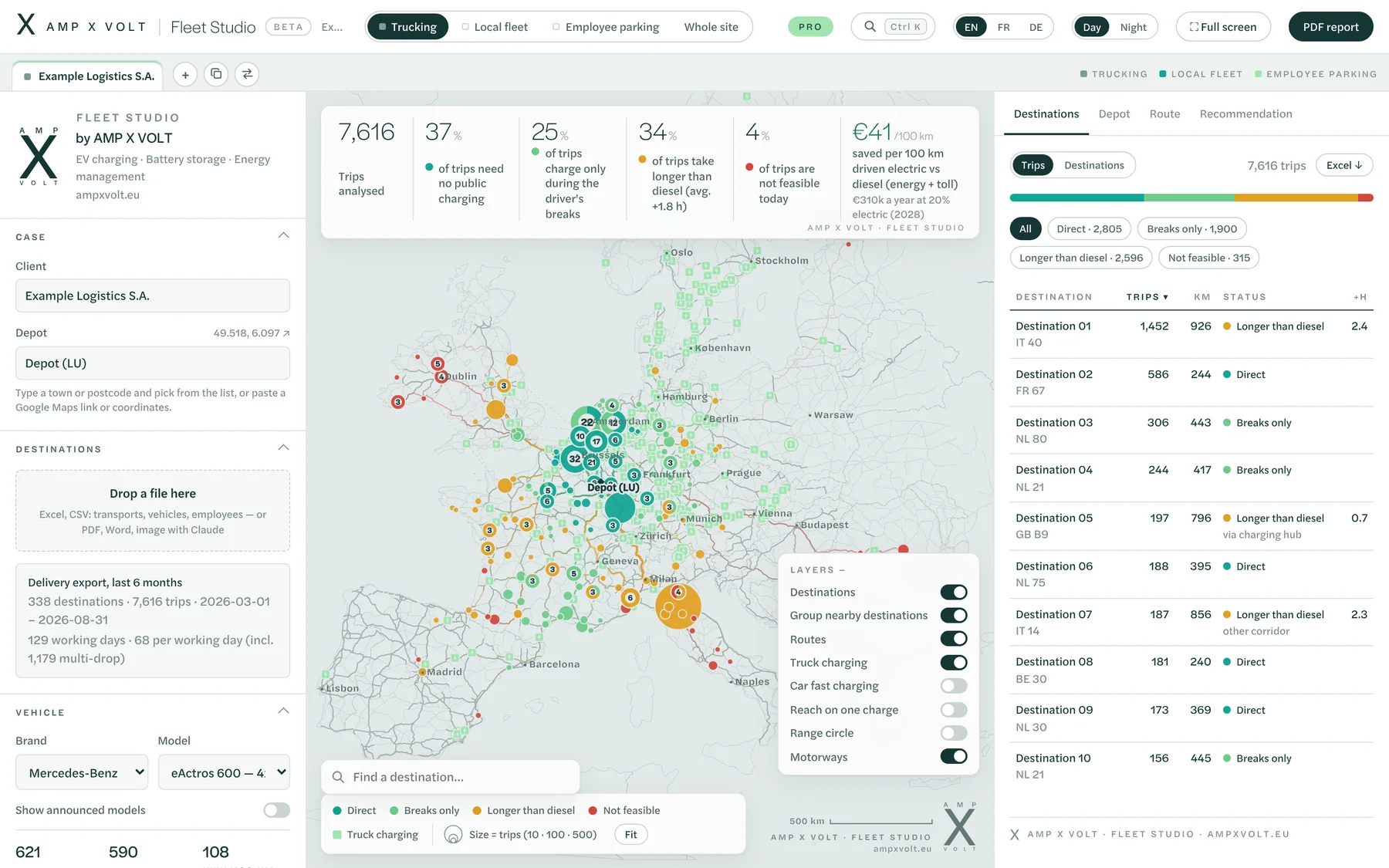
Fleet Studio is our own planning tool. It reads a transport file in the browser, without uploading it, and shows which trips can run electric today, which need a charging break, and what each trip would cost per 100 km against diesel.
The paid Site Study then sizes the depot chargers year by year, the grid connection and the load profile, the equipment and the roadmap to 2030, and is credited against the order.
Aid
Calls for projects come in rounds
In 2026 Luxembourg ran a €10 million call for zero-emission trucks (up to 100% of the extra cost over diesel) and a €4 million call for company truck chargers, both open from 20 July to 18 September, and a €7 million call for AC chargers from 15 January to 15 June. The next rounds are announced on guichet.lu.
A Site Study gives you the technical part of the application before the call opens: feasible routes, the charging plan, the kW and the budget. See subsidies.
Ask your AI assistant
Fleet questions
“How many vans can charge on a 125 A connection?”
“Which DC chargers suit electric trucks in Luxembourg?”
“When does a battery make sense for depot charging?”
“Can a company get EV charging and battery storage without investing?”
“Can AMP X VOLT tell us which of our trips can go electric?”
Start with your trips
Run the Fleet Check on your own file, or send us the depot, the vehicles and the connection: we come back with the proposed solution.